
You know the host I’m talking about. Everyone’s laughing, the music’s good, the night is happening — and the host is somewhere in the background doing a task. Refilling the thing, clearing the plates, glued to the grill, checking the oven for the ninth time. She planned this whole party and she’s experiencing exactly none of it. By the time she finally sits down, everyone’s getting their coats. If you’ve ever wondered how to host without doing everything yourself, this one’s for you.
I know that host well, because that host is me. I’m the one in my family who plans everything, and I will stack my plate to the ceiling without blinking. My brother has a whole analogy for it — he says I put too many pancakes on my plate. Now, before any family function, he’ll kindly ask me: “How many pancakes you got on your plate right now?” Because he knows if he doesn’t check me, I’ll take on every single task and never once think to ask anyone for help.
So this post is personal. It’s part of my mission to free the family planner — that one person in every family who runs the whole show and never actually gets to enjoy it — from being stuck in planner mode all night. Because here’s what I’ve learned the hard way: a great host isn’t the one who does the most. It’s the one who set things up so well that they get to actually be there. Presence is the whole job — and presence is a logistics problem, not a hospitality flaw. Let me show you how to solve it.
How to Host Without Doing Everything Yourself: It’s Not the Food, It’s Handing It Off
Here’s what’s actually going on when a host disappears all night: it’s not that there’s too much to do. It’s that they won’t let anyone else do any of it. Whether you’re the one glued to the grill because nobody else can be trusted with the meat, or the one refilling every cup and clearing every plate because “it’s easier if I just do it” — it’s the same problem wearing different outfits. It’s all a refusal to hand off tasks. Even the cooking. Especially the cooking.
I’m that host, if the pancakes didn’t give it away. And the fix isn’t doing less at your party — it’s setting things up ahead of time and letting other people carry their share. Let me walk you through it.
Do the Work Before Anyone Arrives
The single biggest reason hosts disappear is that they left too much for game time. The fix is front-loading. Anything that can be done ahead, do ahead:
- Build a menu that’s mostly done before guests arrive. Dishes that hold, reheat, or sit out beautifully are your best friends. Save the day-of cooking for one or two things, max. The fancy dish that needs plating at the last minute for twelve people is how you lose your whole evening.
- Prep to the last possible step early. Chop, marinate, assemble, set out serving dishes the night before. When guests arrive, you want to be finishing, not starting.
- Set up your space in advance. Drinks stationed, ice ready, glasses out, trash accessible. Every little thing you’d have to jump up for later is a thing you handle now.
A host who did the prep gets to greet people at the door with a drink in hand. A host who didn’t is answering that same door with tongs in one hand and no idea where the night went.
Let Your Setup Do the Serving
Here’s a mindset shift that changes everything: stop serving your party and start setting it up to serve itself.
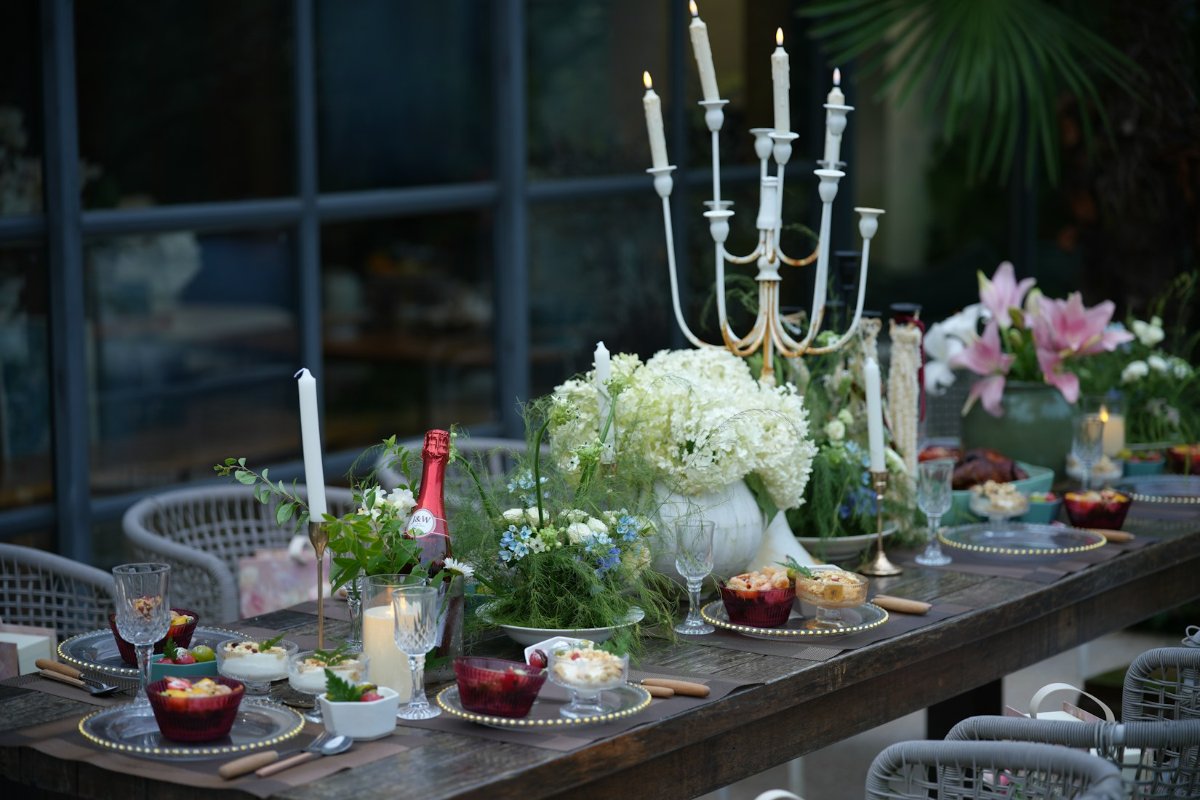
Instead of plating and passing all night, build stations. A drinks station where people pour their own. A grazing board or buffet people help themselves from. A dessert spread you set out once and never think about again. When guests can feed and refill themselves, you’re freed from being the waitstaff at your own event. It also — and this is the secret bonus — makes guests more comfortable, because nobody wants to feel like they’re being waited on by a frazzled friend. Self-serve is hospitality, not laziness.
Delegate Like You Mean It
This is the heart of it, so let me be real with you. To my fellow pancake-stackers who can’t let anyone help: people want to help. Letting them isn’t failing as a host — it’s making them feel included, and it’s saving your night. But here’s the part I had to learn myself, and recently.
This past summer I threw a cookout for my siblings, cousins, and all their kids. And in a rare move for me, I actually put “bring a dish, bring cups, bring something for the grill” right on the invitation — participation required, which is not how I usually operate. I’m normally the “just show up, I’ve got it” host. So this was me trying to take pancakes off my plate. And as the date got close and nobody had said a word about bringing anything, I had a little meltdown to my siblings. I just wanted them to participate without me having to force it.
Then one of my brothers said the thing that fixed me: “Just assign things out. We’ll do whatever you ask — we just need you to tell us what you need.” And it clicked. It was never that my family didn’t want to help. They didn’t know how. A vague “bring something” gave them nothing to grab onto. The communication was on me.
That’s the whole secret. Vague offers and vague asks (“let me know if you need anything!” / “feel free to bring stuff!”) go nowhere. Specific asks get taken every time. So assign real jobs — and yes, that absolutely includes the food. Hand off grill duty. Let someone else own dessert. “Can you keep an eye on the bar and top people off?” “Would you run the music?” “Can you bring the buns and the drinks?” Give your partner or a close friend the role of co-host who actually knows the plan. When you hand people clear, specific jobs, they happily take them — and you’ve just built a whole team without hiring one. Releasing control is the hardest part; I know. But it’s just taking a few pancakes off your own plate and passing them around the table.
Design the Night to Run Itself
The best-hosted parties have an invisible flow — and you can build that flow on purpose:
- Give the night a loose shape. Arrival and drinks, then food, then something that shifts the energy (cake, a toast, a game, the music getting louder). You don’t announce it — you just guide it, so the party has momentum instead of stalling.
- Plan for the lulls. Have the next thing ready before the current thing winds down, so you’re never scrambling in the moment.
- Handle the end, too. Know how you want the night to wrap so you’re not stuck with the last four guests at 1 a.m. wondering how to say goodnight.
When the night has a rhythm you built in advance, it carries itself — and you get to ride along instead of pushing it uphill all evening.
The Whole Point: Be at Your Own Party
Here’s what I want you to take from this, especially if you’re the family planner reading this and nodding. Every bit of prep, every station, every delegated job is in service of one thing: you, present, enjoying the people you invited. That’s the actual goal of hosting — not doing every task yourself so you can say you did. You being fully there is worth more than anything you’d have accomplished hiding in the kitchen. (And if the big family holiday meal is your next test, my holiday dinner survival guide walks that one through too.)
I still have to be reminded to count my pancakes. But the whole reason I do this work is so the person who always plans everything finally gets to sit down and enjoy it too. And when the gathering gets big enough that even perfect prep won’t keep you out of the weeds — a milestone party, a big celebration, an event you really want to be a guest at — that’s exactly when you bring in someone like me. I run the logistics so the host gets to be a guest at their own party. That’s the whole job.
Ready to plan a celebration where you actually get to enjoy yourself? I’d love to hear what you’re dreaming up. Book a discovery call and let’s talk about your event.
Live Intentionally. Celebrate Loudly.